
CLYDEN Double Throw vs Single Throw Cell Lock
This video illustrates the different workings of the double and single throw CLYDEN Cell lock. At first observation, both locks appear identical externally. However, the difference lies in how each lock functions internally.
When turning the key to set the CLYDEN single throw lock in a closed/locked position, the bolt stump extends approximately 32 mm. Performing the same operation on the CLYDEN double throw lock, the bolt stump initially extends only about 16 mm. Using a master key, the CLYDEN double throw lock allows a second turn, extending the bolt stump an additional 16 mm to reach approximately 32 mm. Hence the term double throw — the key must be turned twice for the bolt stump to fully extend to 32 mm, whereas with the CLYDEN single throw lock, only one turn is required for the bolt stump to extend the same 32 mm.
The CLYDEN double throw lock plays a critical role in correctional facilities where wardens need to move prisoners. At night, a supervisor performs the second turn, disabling the warden's key until the following morning when the supervisor unlocks the double throw cell lock, allowing normal operations for the warden to resume.
The double throw has two major flaws. First, the key does not maintain positive engagement with the bolt stump, which can cause the locking action to fail on a worn key. Secondly, worn keys can also place the double throw lock in a state of “half-locking”, where the lock is neither open nor closed and the bolt sits in no-man's-land. In this state, the key cannot be used to unlock or lock the double throw cell lock, which results in the lock being cut out and replaced.
This is how the single throw lock came to be developed. By solving the double throw cell lock's flaws, the single throw cell lock was developed and patented in the early 2000s (Patent No. 2005/09426 “Single Throw Lock”).
The CLYDEN single throw cell lock always maintains positive action between the key and bolt stump, allowing obstacles to be felt by the user. It does not half-lock — it will either work or not, allowing spare keys to enable normal operation. It is cost-effective, as less manufacturing time is required to produce the lock, and it lasts longer than a double throw cell lock, allowing for less service and maintenance and saving the government institution more money.
To date, approximately 50 000 CLYDEN cell locks have been manufactured in the last 30 years, CLYDEN Single Throw Cell lock and CLYDEN Double Throw Cell locks are POL 2012/D5 compatible.
POL 2012/D5 Specification
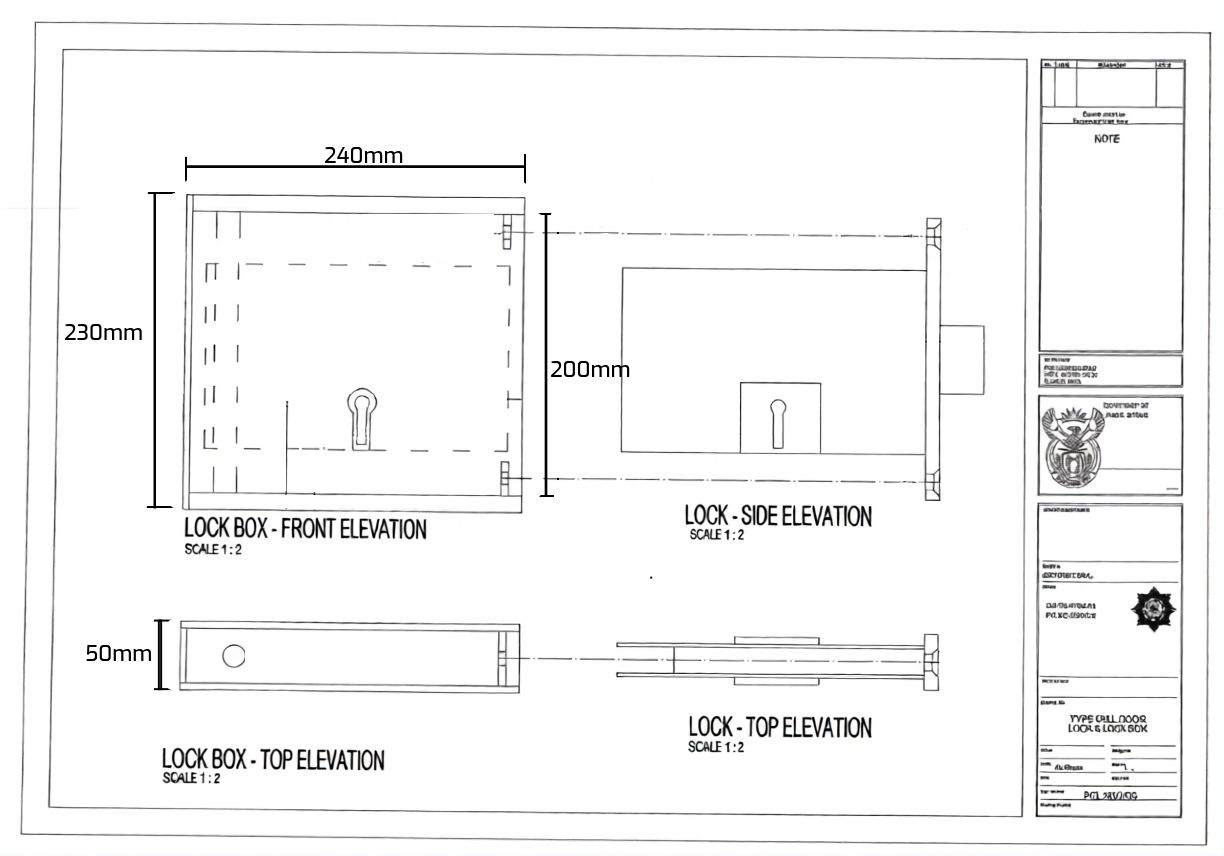
This simplified specification illustrates a lockbox and cell lock. The cell lock face plate measures 200 mm, with the bolt stump extending approximately 32 mm in the locked position. The lockbox dimensions are 240 mm by 230 mm with a thickness of 50 mm.
POL 2012/D4 Specification
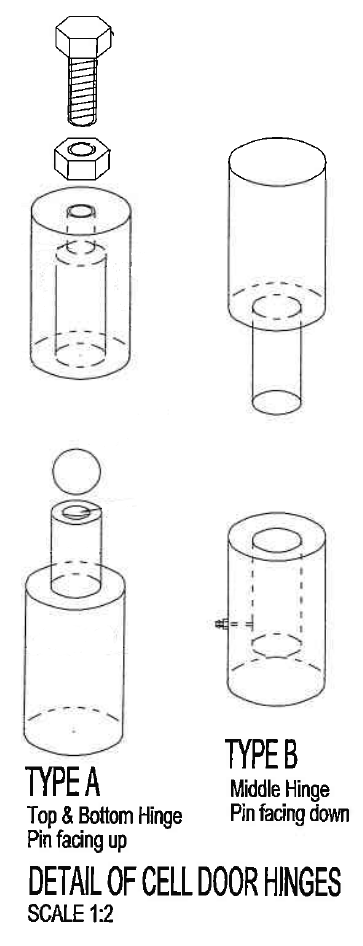
In addition to cell locks, VRC Prospects can also supply lockboxes and hinge sets to customers: a 40 mm bullet hinge compatible with POL 2012/D4. The set includes two ‘A’ hinges for the top and bottom of the cell door, and one ‘B’ hinge — a blank welded upside down in the middle of the cell door. This blank hinge secures the door by preventing it from being removed from the top and bottom ‘A’ hinges. The ‘A’ hinges come with an adjustable screw, allowing the heavy steel door to be seamlessly adjusted with a turn of a spanner. The grease nipples on the ‘A’ hinges allow for easy application of grease to lubricate cell door hinges. Hinge sets are made from special heat-resistant steel so hinges don’t expand when welded.